Understanding how our process differs from traditional incineration
Beginning From Shared Concern
The Philippines has experienced multiple landfill failures and environmental emergencies over the past decades. The Payatas disaster in 2000 took over 200 lives. The Naga City landslide in 2018. The Binaliw landfill collapse in January 2026. The Rodriguez Rizal Provincial Sanitary Landfill failure in February 2026. The Navotas Landfill fire that began in April 2026 and continues to affect air quality across Metro Manila and surrounding provinces.
These are not abstract events. They represent real harm to Filipino communities, real loss of Filipino lives, and real reasons for the Philippines to approach waste management with deep caution. Some environmental organizations and advocacy groups have raised concerns about waste-to-energy and thermal treatment technologies in response to these events and to international experience with traditional incineration. These concerns are legitimate. They reflect serious environmental experience and deserve serious engagement.
Broadgate Energy Philippines begins from this shared concern. We are not here to dismiss environmental advocacy. We are here to operate a technology that we believe addresses these concerns through fundamentally different engineering. This page explains how.
How Broadgate's Process Differs From Mass-Burn Incineration
Both traditional mass-burn incineration and Broadgate's process apply heat to waste materials. To that extent, both are thermal processes. The critical operational differences lie in five specific areas: reactor design, oxygen environment, feedstock controls, emissions management, and carbon capture integration.
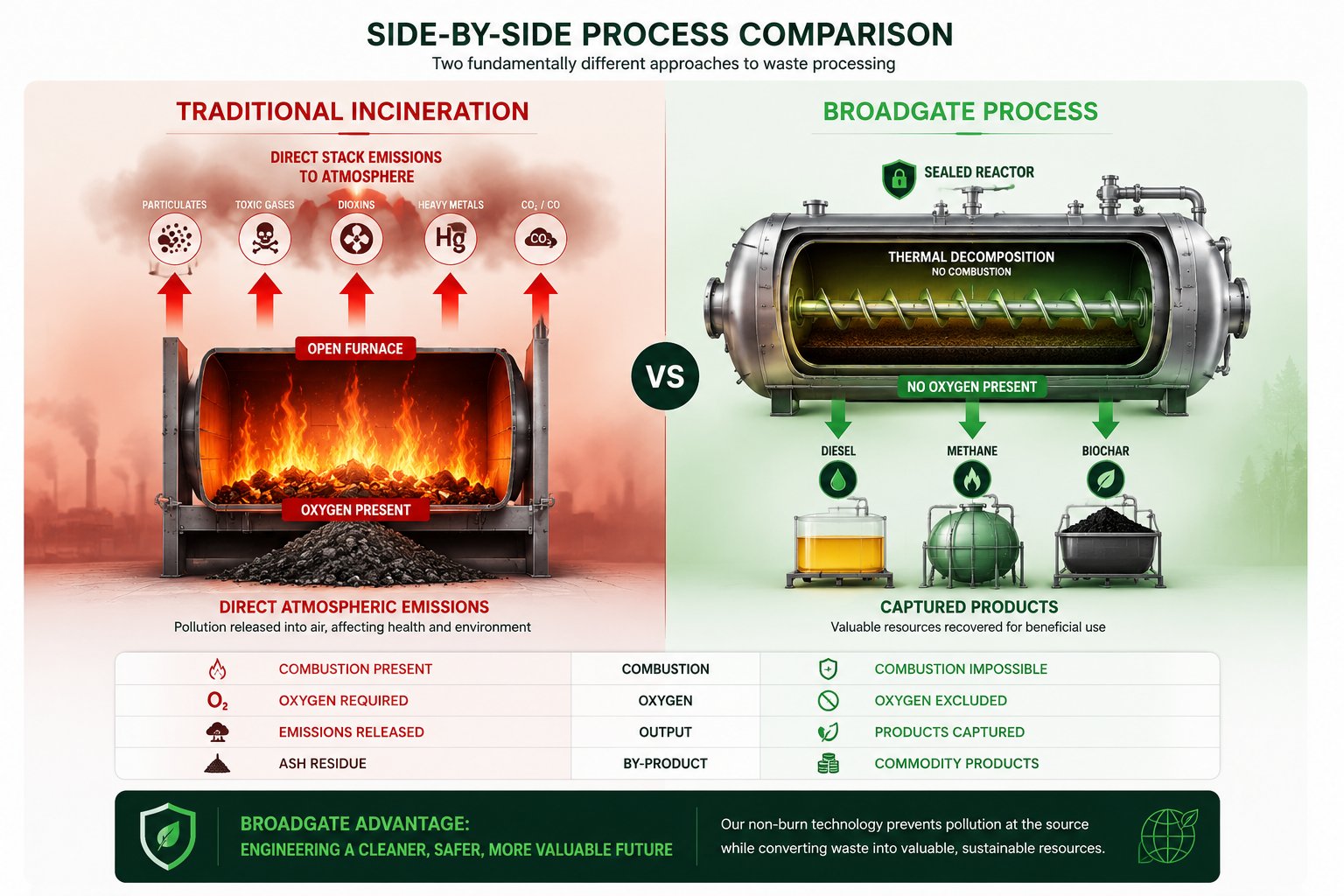
Traditional mass-burn incineration involves open combustion. Waste is burned in the presence of atmospheric oxygen. The combustion produces flames and direct atmospheric emissions including particulates, gases, and trace compounds. The remaining ash requires further disposal. This is the technology pattern that environmental concerns rightly focus on.
Broadgate operates a different engineering pattern. Our reactors are sealed. The internal environment contains no oxygen during operation. With no oxygen present, combustion cannot occur. The waste is heated externally through electrical resistance elements, and thermal decomposition proceeds at the molecular level without flames, without combustion, and without direct atmospheric release. The resulting gases and vapors are captured and refined into commodity products rather than released as emissions.
This is not a marketing distinction. It is an engineering distinction with measurable consequences for emissions performance, environmental impact, and operational safety.
Side-by-Side Process Comparison
Six Operational Distinctions
1. Reactor Design
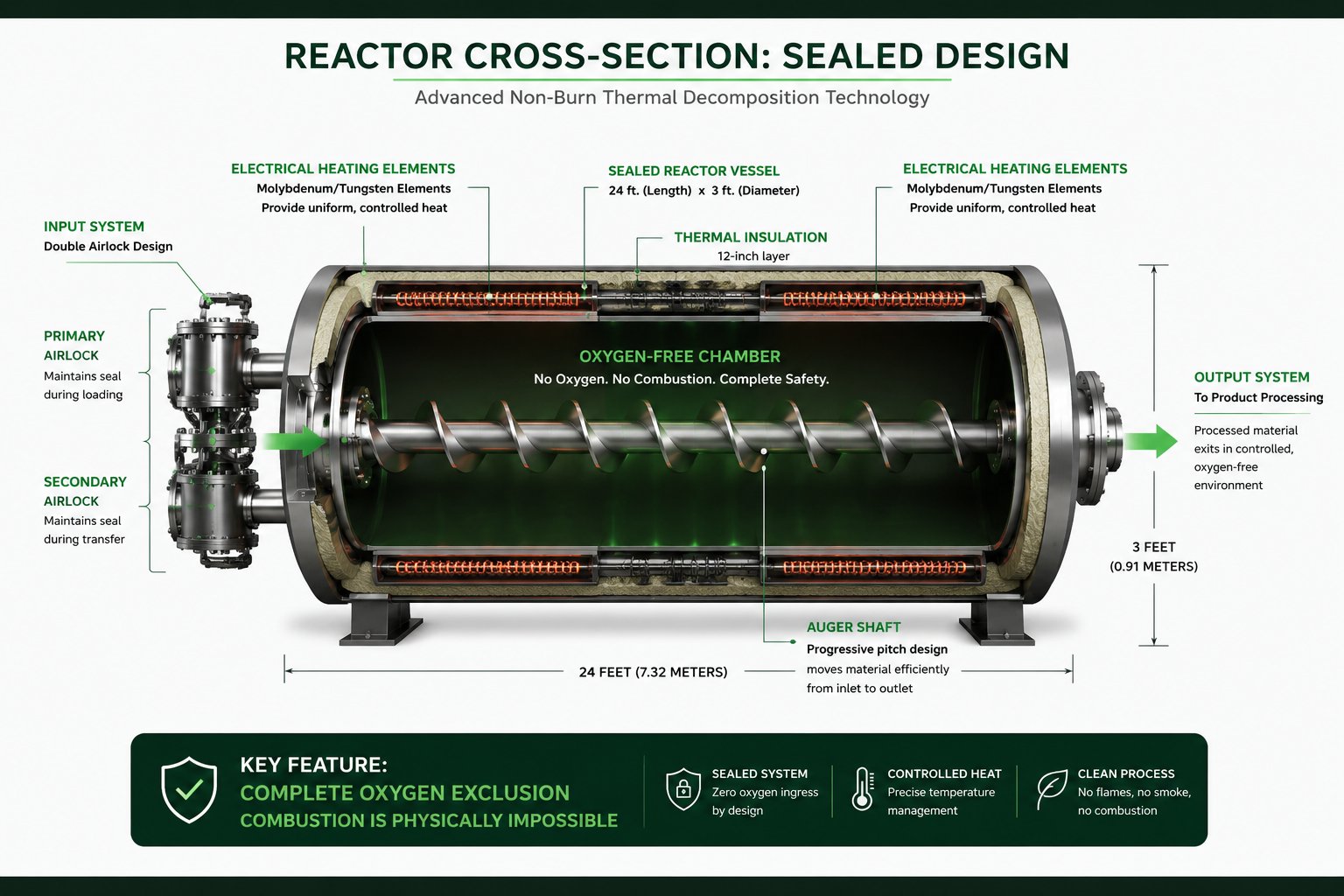
Broadgate reactors are sealed pressure vessels constructed from stainless steel alloys. Each reactor is completely closed during operation. Material enters through a double airlock system that prevents atmospheric air from entering the reactor chamber. Traditional incinerators are open systems where atmospheric air mixes with the waste throughout the combustion process.
2. Oxygen Environment
The Broadgate reactor interior contains no oxygen during operation. Without oxygen, the chemical conditions for combustion do not exist. The waste cannot catch fire. The waste cannot burn. Heat applied externally causes the waste to decompose thermally, but combustion is not part of the process. Traditional incineration requires oxygen as a fundamental input.
3. Heating Mechanism
Broadgate reactors are heated externally by electrical resistance heating elements. The elements heat the reactor wall, which then transfers heat into the chamber. There is no flame inside the reactor. There is no fire. The mechanism is similar in principle to an industrial electric oven. Traditional incinerators rely on the combustion of the waste itself to generate heat, which creates the flame and emission patterns that environmental concerns focus on.
4. Feedstock Controls
Before any material enters a Broadgate reactor, the waste stream is sorted and prepared. PVC plastics, PET plastics, glass, and metals are removed. The exclusion of PVC and PET is particularly important because these materials contain chlorine and other compounds that could produce harmful byproducts. By preventing these materials from entering the reactor at all, Broadgate eliminates the source rather than trying to remediate after the fact.
5. Emissions Management
Gases and vapors produced through thermal decomposition exit the reactor and pass through cooling systems, catalytic refinement units, and fractional distillation columns. The products are separated into distinct streams: renewable diesel, methane gas, biochar, and others. The valuable hydrocarbons become commodity products rather than atmospheric emissions. Traditional incinerators release combustion products directly to atmosphere through stack emissions.
6. Carbon Capture Integration
Carbon dioxide produced during thermal decomposition is captured rather than released. Broadgate uses Liquid Nitrogen Generator technology to convert the captured CO2 into solid form. The captured carbon then serves as industrial feedstock for beverage carbonation or other applications. Traditional incineration releases significant CO2 to atmosphere as part of the combustion process.
How the Process Actually Works
Step 1: Waste Reception
Waste arrives at the facility through accredited transporters. Each delivery is documented and weighed in a fully closed reception hall that prevents dust, odor, and pest concerns.
Step 2: Waste Preparation
The waste is sorted and prepared. PVC, PET, glass, and metals are separated before processing. The remaining waste is reduced to small uniform particle size with controlled moisture content.
Step 3: Double Airlock Entry
The prepared waste enters the sealed reactor through a double airlock system that prevents atmospheric air from entering. An auger shaft moves the material through the reactor while ensuring uniform thermal exposure.
Step 4: Thermal Decomposition
Inside the sealed reactor, electrical resistance heating elements raise the temperature progressively to controlled operational levels. With no oxygen present, the waste undergoes thermal decomposition. The molecular structure breaks down into smaller compounds without combustion.
Step 5: Gas Processing and Refinement
The resulting gases and vapors exit the reactor and pass through cooling systems and twin centrifugal cyclones that separate carbon particles. The cleaned gases enter catalytic refinement units that further break down longer hydrocarbon chains into useful products.
Step 6: Product Separation
Fractional distillation columns separate the products into distinct streams: renewable diesel for industrial applications, methane gas equivalent to natural gas in quality, biochar for agricultural and industrial uses, and bitumen for road construction.
Step 7: Carbon Capture
Carbon dioxide is captured by Liquid Nitrogen Generator technology and converted into solid form for industrial use rather than released to atmosphere.
Reactor Cross-Section: Sealed Design
What We Process and What We Exclude
Materials Broadgate Processes:
Hospital infectious waste and medical waste under DOH frameworks
Municipal solid waste (organic and non-recyclable portions)
Agricultural residues and biomass
Mixed plastic waste excluding PVC and PET
Paper and cardboard waste
Textile waste
Materials Broadgate Excludes:
PVC plastics — removed before processing because these contain chlorine which could produce harmful compounds at high temperatures
PET plastics — removed because these require different processing for proper recovery
Glass — removed because it cannot be thermally decomposed and is better suited to dedicated recycling streams
Metals — removed for separate recycling streams
Hazardous waste outside the medical waste category — not accepted at the facility
This exclusion of specific materials at the feedstock stage is one of the most important environmental safeguards in Broadgate operations. By preventing problematic materials from entering the reactor at all, the conditions that could produce harmful compounds simply do not exist in the process.
What Comes Out and What We Capture
Commodity Products Produced:
Renewable diesel fuel for industrial applications
Purified methane gas at 97 to 99 percent purity, equivalent to natural gas
Biochar (solid carbon residue for agricultural soil enhancement and industrial uses)
Bitumen for road construction
Electricity generated through Organic Rankine Cycle technology
Captured carbon dioxide converted to solid form for industrial applications
What Is Captured Rather Than Released:
Carbon dioxide — captured through Liquid Nitrogen Generator technology and converted to solid form for industrial reuse
Hydrocarbon compounds — captured through cooling systems and refined into commodity products
Particulates — separated through centrifugal cyclones before any gas processing
Heat — used productively in the Organic Rankine Cycle electricity generation system
Each measurable output of Broadgate operations either becomes a commodity product or is captured for industrial reuse. The operational design integrates capture and product recovery throughout the process rather than treating emissions as something to be filtered at the end.
Regulatory Compliance and International Standards
Broadgate operations comply with rigorous international and Philippine regulatory frameworks that apply to thermal waste treatment.
European Union and United Kingdom Standards
Waste Incineration Directive (WID) — EU regulation establishing emission limits and operational requirements for thermal waste treatment facilities. Broadgate operates well below all WID emission limits.
Best Available Techniques (BAT) — EU framework requiring thermal treatment facilities to use the most environmentally protective technology economically available.
Industrial Emission Directive (IED) — EU regulation establishing comprehensive environmental requirements for industrial operations including waste treatment.
International Quality and Environmental Standards
ISO 9001 — Quality management system certification
ISO 14001 — Environmental management system certification
Professional Indemnity Insurance: 2 million GBP from Rokstone Underwriting, regulated by the UK Financial Conduct Authority
Philippine Regulatory Compliance
Department of Health Health Care Waste Management Manual (4th Edition, 2020)
Department of Environment and Natural Resources Administrative Order 2013-22 covering Category D Recycling and Reprocessing Facilities
These frameworks apply to any facility that thermally treats waste, including both traditional incineration and Broadgate's non-burn thermal decomposition approach. Broadgate operations meet or exceed all applicable limits and requirements.
An Open Invitation to Constructive Dialogue
Broadgate Energy Philippines welcomes constructive dialogue with regulators, environmental organizations, academic institutions, healthcare stakeholders, and local communities regarding our technology, emissions controls, and operational standards. We believe that genuine sustainability and rigorous environmental advocacy are complementary rather than opposed.
The Philippine waste management crisis requires both rigorous accountability and serious operational alternatives. We welcome being held to high standards, and we are committed to meeting them. If you represent an organization or institution with substantive questions about Broadgate operations, we invite you to engage with us directly. We will respond substantively to technical inquiries, share regulatory compliance documentation, and discuss community concerns openly.
Our approach is straightforward. We share the underlying concern about Philippine waste management. We propose a specific engineering approach. We welcome scrutiny of that approach. We expect our operational performance to validate the engineering distinctions we have explained on this page.
Questions About Our Technology?
We respond personally to substantive technical inquiries and welcome dialogue with environmental professionals, regulators, and community stakeholders.